
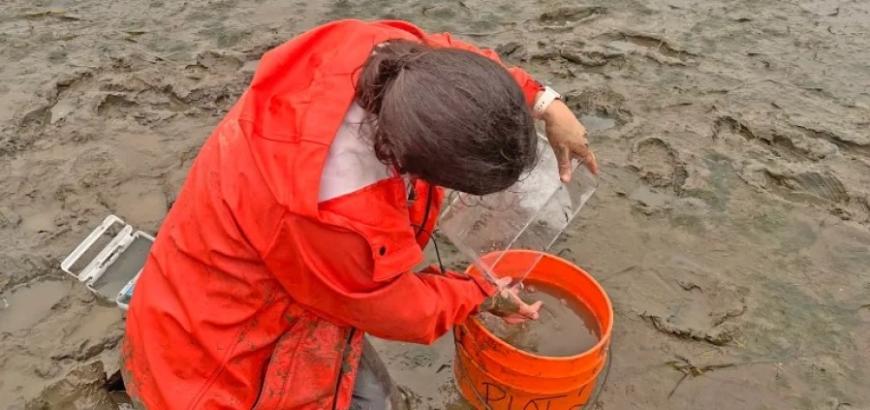
Emma Guerrini Romano, Biology graduate student, was featured in the Chinook Observer on her work researching the basic biology of burrowing shrimp, a native pest species in Willapa Bay, with the goal of helping shellfish farmers control the shrimp populations.
Excerpt from the Chinook Observer article:
Burrowing shrimp are a well-documented native pest species in Willapa Bay that have been a nuisance to bottom-culture shellfish farmers for over a century. Methods for controlling shrimp populations have varied over the years, including mechanical and chemical controls. Most notably, carbaryl — widely used in pet flea collars — was the control method of choice because of its effectiveness at ridding the mudflats of burrowing shrimp, once again making land viable for shellfish farming. Carbaryl is no longer used in Willapa Bay due to a series of environmental and health concerns that came up in the mid-2010s, leading to a legal settlement. Since then, an alternative method for farmers has been a focus of research in the bay.
Pushing the shrimp
Emma Guerrini Romano, a Ph.D. student at the University of Washington, is a new player in the field of burrowing shrimp control but presents a novel angle — leveraging the existing conditions of burrows to make the environment too extreme for burrowing shrimp to live. Essentially, push the shrimp to their physiological limits. The burrow environment is innately challenging — low oxygen and high toxic ammonia buildup make it so shrimp need to be great at managing their behavior to survive. For example, to combat low oxygen, shrimp will ventilate their burrow by beating pleopods, disk-shaped features on the underside of their body. On a cellular level, burrowing shrimp are not well studied, so the basic adaptations they have evolved to persist in the burrow and dominate mudflats have yet to be uncovered. Guerrini Romano’s entire doctoral thesis is focused on understanding the basic biology of burrowing shrimp at a deeper level. The hope is that a greater understanding of their biology will unlock the key to a control method that can be used by farmers.
Burrowing shrimp are classified as crustaceans — more specifically, decapods. Crustaceans include animals like amphipods and barnacles, and decapods, more specifically, encapsulate crustaceans with 10 of their many appendages considered legs. Examples of decapods include lobsters, crabs, and crayfish. Often, decapods will have an enlarged pincer that is sexually dimorphic (specific to the sex of the animal). Burrowing shrimp males have one large claw that falls in this category. There is a lot of research on the physiology of decapods, such as crabs and lobsters, which can be looked at to surmise some of the more basic functions of burrowing shrimp. Some of the adaptations burrowing decapods have include specialized pumps to regulate internal ion concentrations, which can be thought of as parts of salt, and water movement. Ions include chloride (Cl-), sodium (Na+), potassium (K+), and others, and these play large roles in the function and survival of the animal. These pumps are present in many types of marine animals but vary in amounts and concentrations depending on the environment. Some specialized pumps specifically regulate the movement of an ion called ammonium, which is built up in the body naturally as waste, but can be converted to a super toxic form, called ammonia, when pH increases, or becomes more basic. Ammonium, the non-toxic form, builds up in burrows naturally as shrimp eat and excrete sediment.
When thinking about creating a targeted chemical treatment, researchers at UW thought to shift the already present ammonium into toxic ammonia by making the water more basic. The way to do this? Add baking soda!