
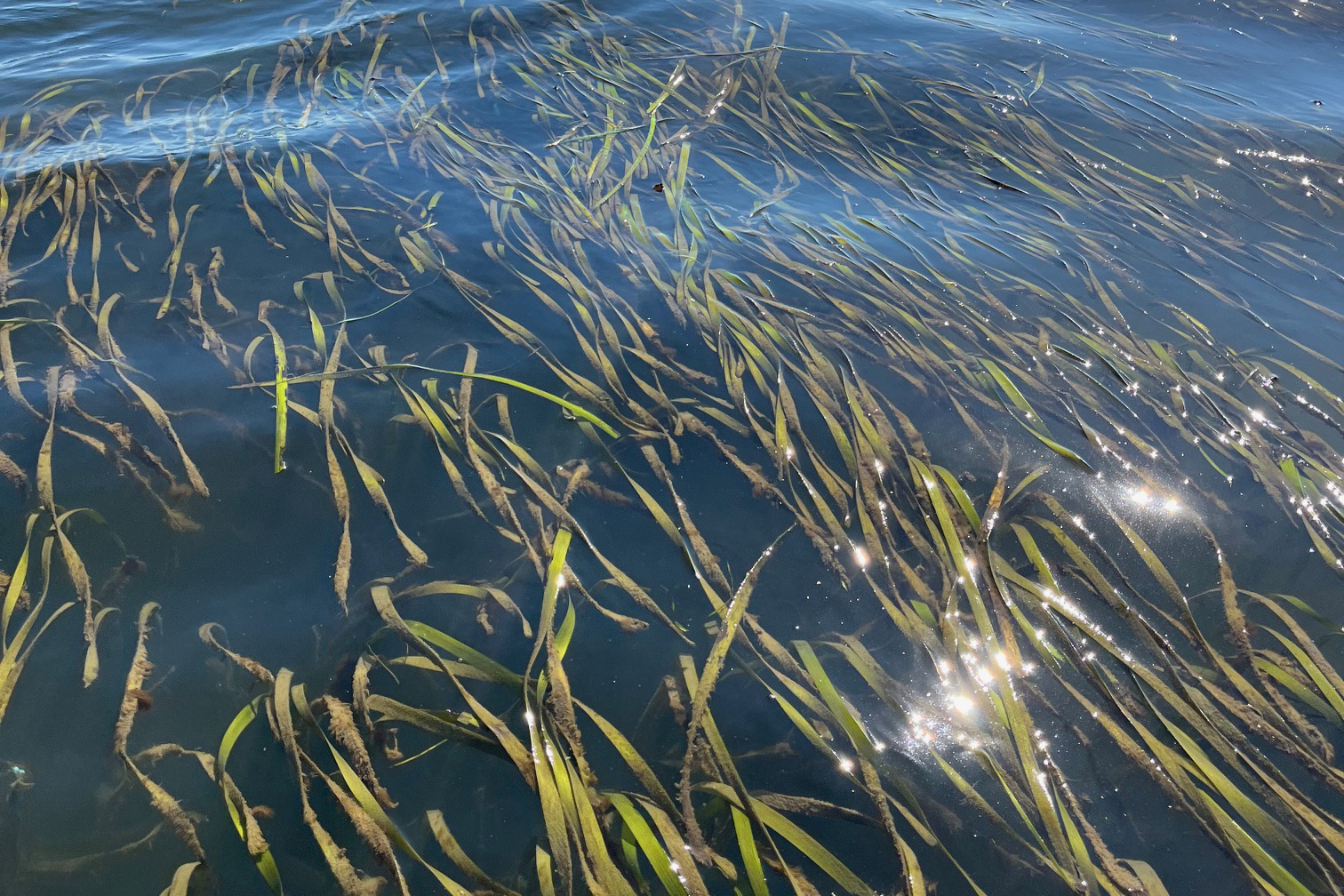
Jennifer Ruesink, UW Biology Professor, studies the relationship between the environment and marine organisms, including eelgrass, the primary species of seagrass that resides in the oceans surrounding Washington. In honor of World Seagrass Day, UW News asked Ruesink to explain what seagrass is and what makes the seagrasses in Washington unique.
Excerpt from the UW News Q&A with Jennifer Ruesink:
What is seagrass and why is it important?
Jennifer Ruesink: Seagrasses are “land plants” that have moved into ocean habitats. They have roots, stems, leaves, flowers, fruits and seeds. There are only about 70 species of seagrasses, representing just 0.02% of all flowering plant species.
Seagrass matters to humans in many ways. It cycles nutrients and carbon, provides habitat for fish and decapods, and it anchors sediment in place, which contributes to shoreline stabilization. It’s a sentinel species for good water quality — in fact, impaired water quality from nutrient pollution, coastal building and erosion are its biggest threats.
Beyond these utilitarian values, seagrass is “wonderful” in the truest sense of that word — the way it grows, moves and shapes the environment provides a continual source of wonder.
What makes seagrass different from seaweed and other ocean plants?
JR: In addition to seagrasses, there are many other photosynthetic organisms that live in the ocean. Collectively they provide half of our global oxygen. But the others are different from seagrasses: Seaweeds, also known as macroalgae, do not make roots or flowers. Tiny microalgae live on ocean surfaces, even on the seagrass leaves themselves. Other photosynthetic organisms, such as phytoplankton, drift as single cells or small colonies in the water.
Seagrasses are colloquially called “grasses” because many have grass-like shapes with long strap-like leaves that grow from the base, and their stems move horizontally underground. From an evolutionary perspective, seagrasses do not group with the terrestrial grass family but instead have unique families or share relatives with freshwater plants.
What does seagrass look like in the ocean?
JR: If you think of a prairie on land, it is full of different plant species that grow to different heights, flower at different times, and extract light and nutrients with different efficiencies. Seagrass meadows are the prairies of the ocean, but they frequently consist of just one seagrass species. Because the number of seagrass species is so small, much of the dramatic variability occurs within single species, rather than across multiple species. Here in Washington we mostly have the same species — eelgrass, or Zostera marina — that’s found from 23-70 degrees north latitude on both sides of the Pacific and Atlantic Ocean.
Tell us about eelgrass in Washington.
JR: The remarkable thing is that there is so much of eelgrass variability present within our state. For example, some populations have shoots that replicate solely by branching, making genetic copies of themselves as they go. Other populations have shoots that never branch, but instead germinate, flower and die within a summer, overwintering as seeds. Shoots in Washington range from a diminutive 0.7 feet to nearly 6.5 feet long.
You can find eelgrass at low tide in the intertidal zone and as deep as 50 feet in the clear water along the Strait of Juan de Fuca. It lives in places that have ocean salinity, but it also lives near rivers where the winter salinities drop to about 85% freshwater. The eelgrass bed protected by the Padilla Bay National Estuarine Research Reserve is estimated at 8,000 acres, and Willapa Bay on the coast contains nearly 14,000 acres. Eelgrass also grows in a narrow “bathtub ring” on steeper soft-sediment shorelines throughout the state.
It makes sense that this diversity within a species is a product of evolving in the varied environments of Washington’s vast and convoluted shoreline. We think this variability should confer resilience to change, but that’s an ongoing exploration.
Washington also has two seagrass species other than Zostera marina: Ruppia maritima, which is a fast-growing species characteristic of brackish channels in saltmarshes, and Nanozostera japonica, which was established in the state in the 1950s after being inadvertently introduced from Japan. You can find them all growing together in a few places.
Read the full interview on UW News.