
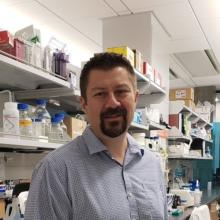
Professor
Fields of Interest
Biography
Research Overview
My lab studies Giardia lamblia. Giardia is an important parasitethat affects a wide variety of animal hosts, including over 100 million (mostly impoverished) people each year. Treatment options are limited; therefore, the WHO has recognized Giardiasis as a neglected disease. In addition toGiardia being a major parasite, this organism stands out as one of the most evolutionary divergent eukaryotes (from animals) that can be manipulated in the laboratory. Many evolutionary studies have placed Giardia at the base of the eukaryotic tree; therefore, Giardia is a window in which evolutionarily deep cellular mechanisms may be examined.
The Cytoskeleton
We are particularly focused on the regulation and function of the cytoskeleton. Both eukaryotic and prokaryotic cells have a cytoskeleton which plays a central role in processes such as regulating cell shape and performing cytokinesis. While the majority of microtubule cytoskeleton components can be identified in the Giardia genome, none ofthe core set of homologous actin-binding proteins (e.g.: nucleators, motors, bundling, and severing proteins), can be found in Giardia. Yet, the Giardia actin cytoskeleton still has complex organization that is dynamically regulated throughout the cell cycle. Moreover, the Giardia actin cytoskeletonhas a conserved role in cellular organization, trafficking, and cytokinesis. Importantly the giardial actin cytoskeleton is both essential and highly divergent from that of humans; therefore, it represents an important potential target for treating this neglected disease and an opportunity to gain insight into evolution of the cytoskeleton.
G-Protein Signaling
In other eukaryotes G-proteins such as Rac, Rho, and CDC42 are upstream of the actin cytoskeleton. These proteins act as molecular switches that control essential cellular processes. Giardia contains a single Rho family GTPase homolog, gRac (versus 22 G-proteins in mammalian cells), which we have demonstrated to play a conserved role in regulating polarity, membrane trafficking, and the cytoskeleton; all of which are essential to viability and pathogenesis. What remains unknown is how these processes are controlled, as Giardia lacks the downstream effectors that typically connect Rho GTPases to other molecular pathways.Novel (and potentially ancient) downstream effectors are hypothesized to link gRac signaling to the cytoskeleton and membrane trafficking. We are focused on determining the manner in which polarized gRac signaling is established, uncovering the extent to which gRac regulates membrane trafficking, and identify the underlying connections between gRac, cell polarity, membrane trafficking, andcytoskeletal dynamics. This work is expected to yield new molecular insights into Rho GTPase biology and lead to the discovery of novel therapeutic targets; furthermore, because Giardia is a deep branching eukaryote, it may also uncover ancestral mechanisms of cell signaling and further establish Giardia as an exemplar of eukaryotic minimalism.
Alex Paredez earned his B.S. in 1998 at UC San Diego. During his senior year he began working on the role of actin binding proteins in C. elegans embryo development, working under Rafi Aroian. After completing his integrated B.S/M.S. in 1999, he entered a PhD program at Stanford University. Still fascinated by the cytoskeleton, Alex worked under Chris Somerville and David Ehrhardt to study the relationship between the plant cortical microtubule array and cell wall organization earning his PhD in 2006. Alex then went to UC Berkeley to postdoc with Zac Cande where he began studying the cytoskeleton of the protozoan parasite Giardia intestinalis. Alex joined the faculty at the University of Washington in 2012.
-
Selected Research
- A Curious Case for Development of Kinase Inhibitors as Antigiardiasis Treatments Using Advanced Drug Techniques, Hennessey Kelly M, Michaels Samantha, Paragas Neil, Paredez Alexander R, and Ojo Kayode K, ACS infectious Diseases, 02/2021 (2021)
- Nek8445, a protein kinase required for microtubule regulation and cytokinesis in Giardia lamblia, Alas Germain C. M., Paredez Alexander R., Hennessey Kelly M, Rogers Ilse, Li Renyu, and Merritt Ethan A, Molecular Biology of the Cell, 05/2020 (2020)
- Identification and Validation of Small- Gatekeeper Kinases as Drug Targets in Giardia lamblia, Hennessey Kelly M., Smith Tess R., Xu Jennifer W., Alas Germain C. M., Ojo Kayode K., Merritt Ethan A., and Paredez Alexander R., PLOS Neglected Tropical Diseases, 11/2016, Volume 10, Issue 11 (2016)
- Identification of obscure yet conserved actin associated proteins in Giardia lamblia., Paredez Alexander R, Cande Zacheus W, Nayeri Arash, Xu Jennifer W, and Krtková Jana, Eukaryotic cell, 2014 Apr 11 (2014)
- Alternative cytoskeletal landscapes: cytoskeletal novelty and evolution in basal excavate protists., Dawson Scott C and Paredez Alexander R, Current opinion in cell biology, 2013 Jan 8 (2013)
- An actin cytoskeleton with evolutionarily conserved functions in the absence of canonical actin-binding proteins., Dawson Scott C, Paredez Alexander R, Assaf Zoe June, Sept David, Timofejeva Ljudmilla, Wang Chung-Ju Rachel, and Cande W Z, Proceedings of the National Academy of Sciences of the United States of America, 2011 Apr 12, Volume 108, Issue 15, p.6151-6 (2011)
- The genome of Naegleria gruberi illuminates early eukaryotic versatility., Fritz-Laylin Lillian K, Prochnik Simon E, Ginger Michael L, Dacks Joel B, Carpenter Meredith L, Field Mark C, Kuo Alan, Paredez Alex, Chapman Jarrod, Pham Jonathan, and Shu Shengqiang, Cell, 2010 Mar 5, Volume 140, Issue 5, p.631-42 (2010)
- Arabidopsis cortical microtubules position cellulose synthase delivery to the plasma membrane and interact with cellulose synthase trafficking compartments., Gutierrez Ryan, Lindeboom Jelmer J, Paredez Alex R, Emons Anne Mie C, and Ehrhardt David W, Nature cell biology, 2009 Jul, Volume 11, Issue 7, p.797-806 (2009)
- Genetic evidence that cellulose synthase activity influences microtubule cortical array organization., Paredez Alexander R, Ehrhardt David W, Persson Staffan, and Somerville Chris R, Plant physiology, 2008 Aug, Volume 147, Issue 4, p.1723-34 (2008)
- Genetic evidence for three unique components in primary cell-wall cellulose synthase complexes in Arabidopsis., Persson Staffan, Somerville Chris R, Paredez Alexander, Carroll Andrew, Palsdottir Hildur, Doblin Monika, Poindexter Patricia, Khitrov Natalie, and Auer Manfred, Proceedings of the National Academy of Sciences of the United States of America, 2007 Sep 25, Volume 104, Issue 39, p.15566-71 (2007)
- Visualization of cellulose synthase demonstrates functional association with microtubules., Paredez Alexander R, Ehrhardt David W, and Somerville Christopher R, Science (New York, N.Y.), 2006 Jun 9, Volume 312, Issue 5779, p.1491-5 (2006)
- The coronin-like protein POD-1 is required for anterior-posterior axis formation and cellular architecture in the nematode caenorhabditis elegans., Rappleye C A, Paredez A R, Smith C W, McDonald K L, and Aroian R V, Genes & development, 1999 Nov 1, Volume 13, Issue 21, p.2838-51 (1999)
-
Spring 2026
Winter 2026
Autumn 2025
Spring 2025
Winter 2025
Autumn 2024
Spring 2024
Winter 2024
Autumn 2023
Spring 2023
Winter 2023
-