
Professor
Fields of Interest
Education
Biography
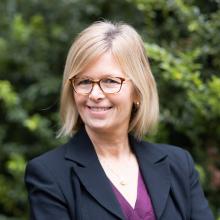
Emily Carrington's research program, in its broadest sense, investigates the physiological ecology of marine organisms. She is particularly interested in the functional design of organisms that inhabit physically demanding environments, such as wave-swept rocky shores, where thermal, osmotic, and hydrodynamic conditions can be extreme. Her research involves both plants and animals and spans many levels of biological organization, from the mechanics of biological materials, to the persistence of populations, to the characterization of the physical environment and how it influences biological processes. A recent focus in her laboratory has been the effects of ocean warming and acidification on mussels, snails and seaweeds.
Emily studied Biological Sciences at Cornell University (BA 1985) and Stanford University (PhD 1992). She was a postdoctoral fellow at the University of British Columbia before joining the faculty of the Department of Biological Sciences at the University of Rhode Island in 1995. She has been on the faculty of the UW Department of Biology since 2005, splitting her time between the Seattle campus and Friday Harbor Laboratories. From 2016-2019, she served as a Program Director at the National Science Foundation in Alexandria, VA in the Directorate for Biological Sciences. She was elected Fellow of the American Association for the Advancement of Science (AAAS) in 2021 for her research contributions in biomechanics and ecophysiology, as well as efforts to promote diversity and inclusion in science.
-
Elected Fellow of the American Association for the Advancement of Science (AAAS), 2021
-
Selected Research
- Resource allocation to a structural biomaterial: induced production of byssal threads decreases growth of a marine mussel, Mytilus trossulus, Sebens Kenneth P, Carrington Emily, LaFramboise Sam A, Roberts Emily A, Newcomb LauraA, McCartha Michelle M, and Harrington Katie J, Functional Ecology, Volume (in press) (2021)
- Estimation of fitness from energetics and life-history data: An example using mussels, Sebens Kenneth P, Sara' Gianluca, and Carrington Emily, Ecology and Evolution (2018)
- Mussels as a Model System for Integrative Ecomechanics, Sebens Kenneth P, Sara' Gianluca, Carrington Emily, and Waite Herbert J, Annual Review of Marine Science, Volume 7, p.9.1-9.27 (2015)
- Symposium on “Climate Change and Molluscan Ecophysiology” at the 79th Annual Meeting of the American Malacological Society, Carrington Emily, Marko Peter B, Rosa Rui, Giomi Folco, Troschinski Sandra, Melzner Frank, and Seibel Brad A, American Malacological Bulletin, 03/2015, Volume 33, Issue 1, p.121 - 126 (2015)
- Mussels as a Model System for Integrative Ecomechanics, Carrington Emily, Sebens Kenneth P, Waite Herbert J, and Sarà Gianluca, Annual Review of Marine Science, 01/2015, Volume 7, Issue 1, p.443 - 469 (2015)
- Foraging behavior minimizes heat exposure in a complex thermal landscape, Carrington E, Hayford HA, and Gilman SE, Marine Ecology Progress Series, 01/2015, Volume 518, p.165 - 175 (2015)
- An inland sea high nitrate-low chlorophyll (HNLC) region with naturally high pCO2, Carrington Emily, Murray James W, Roberts Emily, Howard Evan, O'Donnell Michael, Bantam Cory, Foy Mike, Paul Barbara, and Fay Amanda, Limnology and Oceanography, 02/2015, p.n/a - n/a (2015)
- The effect of water temperature and velocity on barnacle growth: Quantifying the impact of multiple environmental stressors, Carrington Emily and Nishizaki Michael T, Journal of Thermal Biology, 2/2015 (2015)
- The effect of water temperature and flow on respiration in barnacles: patterns of mass transfer versus kinetic limitation. , Nishizaki M T and Carrington E, J. Exp. Biol. , 03/2014, Volume 217, p.2101-2109 (2014)
- Temperature-dependent photosynthesis in the intertidal alga Fucus gardneri and sensitivity to ongoing climate change, Carrington Emily, Colvard Nicholas B, and Helmuth Brian, Journal of Experimental Marine Biology and Ecology, 09/2014, Volume 458, p.6 - 12 (2014)
- Temperature and water flow influence feeding behavior and success in the barnacle Balanus glandula, Nishizaki M T and Carrington E, Marine Ecology Progress Series, 07/2014, Volume 507, p.207 - 218 (2014)
- Detecting the Unexpected: A Research Framework for Ocean Acidification, Carrington Emily, Baumann Hannes, Pfister Catherine A, Esbaugh Andrew J, Frieder Christina A, Bockmon Emily E, White Meredith M, Carter Brendan R, Benway Heather M, Blanchette Carol A, and McClintock James B, Environmental Science & Technology, 09/2014, Volume 48, Issue 17, p.9982 - 9994 (2014)
- Spine reorientation influences drift particle capture efficiency in sea urchins, Carrington Emily and George Matthew N, Journal of Experimental Marine Biology and Ecology, 12/2014, Volume 461, p.102 - 106 (2014)
- Shifts in morphological and mechanical traits compensate for performance costs of reproduction in a wave-swept seaweed, Harley C D G, Carrington E, Demes KW, and Anderson LM, Journal of Ecology, Volume 101, p.963-970 (2013)
- Attachment strength of the mussel Mytilus galloprovincialis: effect of habitat and body size., Carrington E and Babarro JMF, J. Exp. Mar. Biol. Ecol., Volume 443, p.188-196 (2013)
- Sex-specific temperature dependence of foraging and growth of intertidal snails., Carrington E, Vaughn Dawn, and Turnross O, Marine Biology (2013)
- High-endurance algae, Carrington Emily, Nature, Volume 503, p.345-346 (2013)
- Mussel byssus attachment weakened by ocean acidification, Carrington Emily, O'Donnell Michael J, and George Matthew N, Nature Climate Change, 03/2013 (2013)
- Seasonal disturbance to mussel beds: Field test of a mechanistic model, Carrington Emily, Limnology and Oceanography, 2009, Volume 54, Issue 3, p.978-986 (2009)
- Mussel attachment on rocky shores: the effect of flow on byssus, Carrington Emily, Integrative and Comparative Biology, 2008, Volume 48, Issue 6, p.801-807 (2008)
- Along the silk road, spiders make way for mussels, Carrington Emily, Trends in Biotechnology, 2008, Volume 26, Issue 2, p.55-57 (2008)
- Interspecific comparison of the mechanical properties of mussel byssus, Carrington E and Brazee Shanna L, Biological Bulletin, 2006, Volume 211, Issue 3, p.263-274 (2006)
- Seasonal variation in mussel byssal thread mechanics, Carrington E and Moeser G M, Journal of Experimental Biology, 2006, Volume 209, Issue 10, p.1996-2003 (2006)
- The hydrodynamic effects of shape and size change during change during reconfiguration of a flexible macroalga, Carrington E and Boller M L, Journal of Experimental Biology, 2006, Volume 209, Issue 10, p.1894-1903 (2006)
-
Spring 2026
Winter 2026
Autumn 2025
Spring 2025
Winter 2025
Autumn 2024
Spring 2024
Winter 2024
Autumn 2023
Spring 2023
Winter 2023
-