
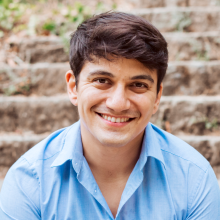
Assistant Professor
Fields of Interest
Biography
We combine mathematical modeling, human stem cell genome-editing, and fluorescence microscopy to study how the actin cytoskeleton produces force to function in cellular membrane bending and trafficking processes. Our research focuses on the mechanical relationship between the actin cytoskeleton and mammalian endocytosis. We aim to identify mechanisms by which emergent architectures of cytoskeletal networks arise based on the initial positions and geometries of endocytic actin-binding proteins. We also study the mechanisms by which the cytoskeleton actively adapts to changing loads to ensure the timely completion of endocytosis.
Matt Akamatsu received his PhD in the department of Molecular Biophysics and Biochemistry at Yale University as the first student in Yale's Integrated Graduate Program in Physics, Engineering and Biology. He worked in Tom Pollard's lab to study the mechanisms by which fission yeast cells assemble and position their cytokinetic contractile ring for symmetrical cell division. He carried out postdoctoral work as an Arnold O. Beckman researcher at UC Berkeley in the department of Molecular and Cellular Biology, coadvised by Padmini Rangamani (UC San Diego) and David Drubin. There, he combined computational modeling, genome editing of human stem cells, and quantitative fluorescence microscopy to study the mechanisms by which the actin cytoskeleton organizes, produces force, and responds to resistance during mammalian endocytosis. Matt is a recipient of the K99 Pathway to Independence Award, UC Berkeley Outstanding Postdoc Award in the Department of Molecular and Cellular Biology, and the 2020 Porter Prize for Research Excellence from the American Society for Cell Biology. He started his lab at UW in June 2022.
-
Selected Research
- Mechanistic insights into actin force generation during vesicle formation from cryo-electron tomography, Akamatsu Matthew, Vasan Ritvik, Serwas Daniel, Rangamani Padmini, Schöneberg Johannes, Drubin David G., Moayed Amir, Vegesna Karthik, Hill Jennifer M., and Davies Karen M., Developmental Cell (2022)
- Value of models for membrane budding, Akamatsu Matthew, Rangamani Padmini, and Lee Christopher T., Current Opinion in Cell Biology, Volume 71, p.38–45 (2021)
- Principles of self-organization and load adaptation by the actin cytoskeleton during clathrin-mediated endocytosis, Akamatsu Matthew, Vasan Ritvik, Serwas Daniel, Ferrin Michael A, Rangamani Padmini, and Drubin David G, eLife, Volume 9 (2020)
- Membrane curvature underlies actin reorganization in response to nanoscale surface topography, al. et, Akamatsu Matthew, Zhao Wenting, Lou Hsin-Ya, Santoro Francesca, Cui Yi, Li Xiao, Duan Liting, Powers Alexander, Mcguire Allister F., and Drubin David G., Proceedings of the National Academy of Sciences, Volume 116, p.23143–23151 (2019)
- Genome-edited human stem cells expressing fluorescently labeled endocytic markers allow quantitative analysis of clathrin-mediated endocytosis during differentiation, Akamatsu Matthew, Drubin David G, Dambournet Daphné, Sochacki Kem A, Cheng Aaron T, Taraska Justin W, and Hockemeyer Dirk, The Journal of cell biology, Volume 2, p.jcb.201710084–11 (2018)
- Analysis of interphase node proteins in fission yeast by quantitative and superresolution fluorescence microscopy, Akamatsu Matthew, Pollard Thomas D, Lin Yu, and Bewersdorf Joerg, Molecular biology of the cell, Volume 28, p.3203–3214 (2017)
- Nanoscale manipulation of membrane curvature for probing endocytosis in live cells, Akamatsu Matthew, Drubin David G, Zhao Wenting, Hanson Lindsey, Lou Hsin-Ya, Chowdary Praveen D, Santoro Francesca, Marks Jessica R, Grassart Alexandre, Cui Yi, and Cui Bianxiao, Nature nanotechnology, Volume 12, p.750–756 (2017)
- Cytokinetic nodes in fission yeast arise from two distinct types of nodes that merge during interphase, Akamatsu Matthew, Berro Julien, Pu Kai-Ming, Tebbs Irene R, and Pollard Thomas D, The Journal of cell biology, Volume 204, p.977–988 (2014)
- Measuring Affinities of Fission Yeast Spindle Pole Body Proteins in Live Cells across the Cell Cycle, Pollard Thomas D, McCormick Chad D, Akamatsu Matthew S, and Ti Shih-Chieh, Biophysj, Volume 105, p.1324–1335 (2013)
-
Spring 2026
Winter 2026
Autumn 2025
Spring 2025
Winter 2025
Autumn 2024
Spring 2024
Winter 2024
Autumn 2023
Spring 2023
Winter 2023
-